Vascular Surgeons Donate
Expertise to Help Soldiers Injured in Combat
June
7, 2008 --
The development of vascular surgery has much to do with
the battlefield,
and in each war, successive advances in vascular repair were
made in treatments that were then brought home to the civilian
population.
As Dr. Norman Rich, who served in Vietnam and developed
the Vietnam Vascular Registry, explains in this short video
clip from Angioplasty.Org's
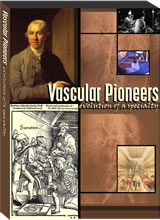
documentary, "Vascular Pioneers: Evolution of a Specialty":
"Hippocrates
said that if you want to be a surgeon, follow an army."
So it is
no surprise that all it took was a quick e-mail to members
of the Society for Vascular Surgery (SVS), to convince them
to volunteer
their expertise to help soldiers who have been injured in
combat in Iraq and Afghanistan. The study will be presented
during the Vascular Annual Meeting, June 5-8, in San Diego,
California
Much of
the development of vascular surgery has taken place on the
battlefield -- this story is told by Drs. Norman M. Rich,
F. William Blaisdell, Michael E. DeBakey and Clement R. Darling,
III
The call to action came from David Gillespie, MD, chief of vascular
surgery at Walter Reed Medical Center in Washington D.C., who asked
volunteers to serve in two-week rotations at Landstuhl Regional Medical
Center (LRMC) in Landstuhl, Germany. The LRMC serves as the primary
evacuation facility for all combat casualties from Iraq and Afghanistan.
Details of this project were revealed during a special presentation
at the 62nd Annual Meeting of the SVS.
Eighteen volunteers have served rotations for 20 weeks and some have
started their second rotation. More are expected to arrive in June
and volunteers are currently scheduled through December 2008. The
U.S. Army provides housing for this project and the American Red
Cross covers malpractice insurance. Civilian vascular surgery volunteers
are providing clinical and educational expertise enhancing the delivery
of sophisticated, state of the art care in support of what is being
provided by the military's few vascular surgeons.
Ruth L. Bush, MD, MPH, associate professor and director of the vascular
fellowship at Scott & White Hospital/Texas A&M University Health Sciences Center in Temple, Texas, said very few of the volunteers have prior military experience but all have vascular trauma experience through residency, fellowship and current practices.
“ Most definitive vascular repairs are being done in theater by military vascular surgeons prior to evacuation of casualties to Landstuhl,” said Dr. Bush. “The wounds are often massive and devastating with a combination of blast and penetrating injuries most commonly from improvised explosive devices or rocket-propelled grenades. Our volunteers are most often called upon for clinical expertise in the care of combat casualties, as well as performing general and vascular procedures intraoperatively. There are a variety of cases, with the most common being wound examinations under anesthesia for which intraoperative vascular consultation was requested (8 to 20 cases per volunteer).”
Additional procedures performed include IVC filter placement; thrombectomy
and revision of lower and upper extremity interposition vein grafts;
retroperitoneal spine exposures; diagnostic and therapeutic (vascular
embolization) carotid angiograms; and endoluminal angioplasty and
stent procedures; as well as Duplex ultrasound interrogation of vascular
repairs, suspected arterial injuries and deep vein thrombosis.
In addition to reporting number and types of procedures performed,
volunteers were queried on their experience and impression of the
rotation. According to Dr. Bush, all current volunteers expressed
gratitude for the experience and were humbled to witness not only
the injuries and young age of the wounded, but also the teamwork
and constant dedication from the surgeons and staff that occur at
LRMC for the injured soldiers.
"With a limited number of military vascular surgeons and the unpredictable
need for a specialist at LRMC, our volunteers are playing an important role in
providing
high quality vascular care for the nation’s wounded soldiers by expanding vascular
and endovascular capability at LRMC,” added Dr. Bush. “These SVS members are
carrying on a tradition started by our surgical forefathers during previous U.S.
military conflicts, and have welcomed the opportunity to give back of their time
and skills to those who have already given so much for their country."
About the Society for Vascular Surgery
The
Society for Vascular Surgery (SVS) is a not-for-profit society
that seeks to advance excellence and innovation in vascular health
through education, advocacy,
research and public awareness. SVS is the national advocate for 2,400 vascular
surgeons dedicated to the prevention and cure of vascular disease. Visit the
website at http://www.VascularWeb.org.
About "Vascular Pioneers:
Evolution of a Specialty" "
Vascular Pioneers: Evolution
of a Specialty" chronicles the story of this young and rapidly
changing field of medicine, as told by pioneering physicians
who have revolutionized the treatment of vascular disease.
From the 20th century battlefields that led to innovations
in surgical repair of arteries to 21st century application
of minimally invasive endovascular techniques, surgeons from
John Hunter to Michael DeBakey and Juan Parodi exemplify how
medical innovation results from individual vision. This 52-minute
documentary includes interviews with 20 prominent physicians.
Part I tells the history of vascular medicine. Part II is a
lively and controversial discussion among key players in the
field regarding the challenges and opportunities presented
by evolving approaches to the treatment of vascular disease
today. The documentary was written, produced and directed by
Burt Cohen with Hugh G. Beebe, MD, FACS as executive producer.
The video was made possible by an educational grant from John
E. Abele, Founder Chairman, Boston Scientific Corporation.
The DVD can be purchased
online from Angioplasty.Org.
Source: Society for Vascular Surgery and
Angioplasty.Org