|
Abbott's XIENCE V® Drug-Eluting
Stent Superior to Boston Scientific's TAXUS® at One Year
Spirit IV Trial of 3,690
Patients Shows a 38% Reduction in Target Lesion Failure with
XIENCE
|
 |
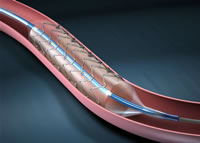
XIENCE V™ Everolimus
Eluting
Coronary Stent System |
|
September
23, 2009 -- San Francisco -- A new study shows that
after one year the second generation XIENCE
V drug-eluting stent from
Abbott
(NYSE:
ABT)
was
more effective in keeping coronary arteries open than
Boston Scientific's (NYSE: BSX) older TAXUS
stent. In presenting the
results
of
the SPIRIT
IV
clinical trial at
this morning's session of the TCT 2009 in San Francisco,
principal investigator Dr. Gregg W. Stone stated,
"The SPIRIT IV results show that XIENCE V significantly
reduces a patient's risk of
experiencing a heart attack, the need for a repeat
procedure or stent thrombosis."
|
The results were striking: Target Lesion Revascularization
(TLR) -- a situation where the stented artery has to be re-opened
because of reduced blood flow -- occurred almost twice as often in
patients who received the TAXUS (4.6%) as opposed to the XIENCE V (2.5%).
Both of these measures, however, are far lower than the restenosis
rates historically seen with bare metal stents, which hovered in
the 15-25% range. Another measure, a new FDA-requested end-point,
called
Target
Lesion
Failure
(TLF) had similar results. TLF is a composite of cardiac death,
heart attack attributed to the target vessel (target vessel myocardial
infarction),
and ischemia-driven
TLR (ID-TLR) and it occurred in 4.2% of XIENCE V patients and 6.8%
for TAXUS, a
38% reduction for the Abbott stent.
The breakdown for cardiac death or MI (heart attack)
favored XIENCE (2.2% vs 3.2%) but did not reach statistical
significance. Another measure of safety that has been of much concern
with drug-eluting stents was that of stent thrombosis. Again the
data favored XIENCE (0.29% vs 1.06%) but even a trial of this size
is not powered to compare very low frequency
events, such as stent thrombosis.
SPIRIT IV enrolled a cohort
of 3,690 patients. Dr. Stone, Professor of Medicine at Columbia
University Medical Center in New York, noted that this was a
more powerful trial than earlier SPIRITs and was the largest
head-to-head comparison of two drug-eluting stents to date. The
trial also included a large number of diabetic patients -- Dr.
Stone noted that there were more diabetic patients in SPIRIT
IV than the total number of patients in the SPIRIT II trial.
An important difference from other studies was that clinical
decisions about whether the coronary artery stayed open were
measured by whether or not the patient required a second procedure,
not by angiographic follow-up, making the trial results more "real-world". |
|

Gregg W>
Stone MD |

Jeffrey J.
Popma
MD |
|
Commenting on the study, Dr.
Jeffrey J. Popma of Beth Israel in Boston, praised the trial's
design,
saying
that
by
taking all comers, complex patient groups and not using angiographic
follow-up as the measure, this was the "right study".
Popma stated, "In
some of the earlier studies of CYPHER vs. TAXUS, I had questions,
I don't have any questions now about XIENCE vs. TAXUS."
One question that some cardiologists have raised is that,
with several recent studies showing a "late catch-up" effect
with drug-eluting stents from three to five years out, with
the
possible exception of Medtronic's Endeavor, will the differences
between the XIENCE and TAXUS remain as great in four more years?
|
For example, another study presented this morning,
the SIRTAX-LATE showed that the differences between the CYPHER and
TAXUS
stents seen
in the first
year became statistically not significant by year five, because of
a greater late catch-up effect with the CYPHER sirolimus-eluting stent.
One area where the XIENCE and TAXUS were no
different was in diabetic patients. TAXUS, which uses
the drug paclitaxel, has shown good results with diabetics over
many trials. However, one take-away from this trial is the increased
safety and efficacy of the second generation of drug-eluting stents.
Dr. Stone attributed this improvement to a number of factors:
a better
stent platform
with
thinner
struts, a new and thinner drug-eluting polymer, and a different
drug. When asked what the clinical implications of the SPIRIT
IV study
were for him, he replied, "Whenever we have a patient in the
cath lab, we want to choose the safest, most effective stent. And
today
that's
the XIENCE -- for
non-diabetics. For diabetics, it's not as clear."
Reported by Burt Cohen, September 23, 2009
|