February 9, 2011 --
After reviewing numerous studies that compared the use of drug-eluting
stents (DES) to that of bare metal stents (BMS) in the treatment
of chronic total occlusions (CTO) in the coronary arteries, a
team of Texas cardiologists has concluded
that the use of "DES is associated
with significant reductions
in angiographic
and clinical restenosis with similar safety. The consistency
and magnitude of treatment effect across both individual trials
and the pooled analysis establish DES as the preferred therapy
for percutaneous revascularization of CTOs."
This meta-analysis is published in the February
issue of Catheterization and Cardiovascular Interventions,
the official journal of The
Society for Cardiovascular Angiography and Interventions (SCAI) by
Emmanouil Brilakis, MD, PhD, FSCAI of VA North Texas Healthcare
System and the University of Texas Southwestern Medical Center
in Dallas, and colleagues. The researchers performed a systematic
review of medical literature published in online databases
(PubMed,
EMBASE, Cochrane Library) and cardiology societies’ web sites
and they found 17 published studies that reported
outcomes for sirolimus-
or paclitaxel-eluting stents and BMS implantation for coronary
occlusions.
Chronic total
occlusions historically have been the most difficult blockages
to tackle: they routinely
have a low rate of procedural success and, even then, there is
a high incidence of restenosis or target vessel failure. This
difficulty has been present since the beginnings of angioplasty.
As Andreas Gruentzig, the inventor of coronary angioplasty,
stated in this 1985 interview, "If we cannot solve the total
closure problem, we probably will never really address the
question of multivessel disease dilatation." Although
this interview was conducted before the introduction of stents,
which have
made
a great
advance
in
this area, and Gruentzig was referring to "dilatation" (balloon
angioplasty), the
challenges
of CTOs remain. Many cardiologists will refer their CTO patients
to those interventionalists who specialize in this
area, many of whom will be attending the Eighth
Annual Chronic Total Occlusion Summit, being
held in New York City next week.
Andreas Gruentzig,
MD in 1985
One of the biggest difficulties in performing angioplasty on a total
occlusion is the fact that, under angiography, the cardiologist is
unable to see the part of the artery beyond the occlusion, since
the flow of contrast dye is blocked completely. There have been numerous
imaging systems that have attempted to overcome this limitation,
often combining CT and angiography, or other modalities, using magnetic
fields or ultrasound to guide the wire and catheter through the invisible
obstruction -- the danger being that a wrong turn might send the
guide wire through the arterial wall, instead of the blockage, causing
a dissection. A new technology that may become available in the near
future is Forward Looking Intravascular Ultrasound (FLIVUS) that
uses the well-known intravascular imaging technique of IVUS to guide
and treat the blockage.
But whether the obstruction gets opened successfully is only part
of the solution. These chronic blockages have a high incidence of
reclosure, so the optimal device for keeping the blockage clear is
critically important -- and this study points to drug-eluting stents
as the preferred type. In almost all of the studies, DES had better
results and, in the four that tracked patients to three years,
the incidence of death, MI, and stent thrombosis remained similar
between
patients
with BMS and DES while Target Lesion Revascularization (TLR) and
Target Vessel Revascularization (TVR) were significantly lower in
the DES
group in three of
four
studies and similar
in
another. And, although there are still some who are concerned over
late stent thrombosis or other adverse effects of DES, mortality
was similar among all stents.
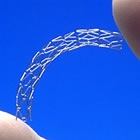
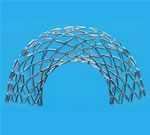
Endeavor
drug-eluting stent
Of interest is that the available
studies were only able to compare bare metal stents to the first
generation drug-eluting stents, namely sirolimus (Cypher) and
paclitaxel (Taxus) devices.
As the authors noted, the newer Endeavor
and XIENCE/Promus stents may yield even better results, because
they are structurally more sophisticated, with thinner struts
and more flexible linkages. Currently, four studies are in
progress worldwide to measure just how much better these newer
stents
may perform.
But for the moment, the conclusion of the
authors is that:
"Our review demonstrates that in CTO published
studies, compared to BMS, DES: (a) consistently reduce angiographic
restenosis; (b) reduce target lesion and target vessel revascularization;
and (c) appear to be safe with similar rates of death, myocardial
infarction and stent thrombosis. A benefit from using DES in
CTOs is anticipated, as CTOs are frequently long lesions in diffusely-diseased
vessels, requiring implantation of multiple stents, with
high restenosis rates if BMS are used. Yet, the consistency
of the direction and magnitude of the angiographic and clinical
benefit
is remarkable across the published studies. The
improved outcomes after CTO stenting with DES may in part be responsible
for the renewed interest for treating such lesions. Although
crossing the CTO remains the main technical challenge of CTO
PCI,
novel techniques including retrograde PCI are increasing procedural
success and in combination with DES implantation could
provide excellent results."