|
Pooled Analysis of XIENCE
V vs. Taxus Trials Shows Positive Long-Term Data for Abbott Stent
|
 |
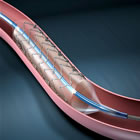
Abbott's
XIENCE V
Everolimus-Eluting Stent |
|
April 3, 2011 --
In yesterday's "preview"
of interventional news from the 60th Annual American College
of Cardiology Scientific Session taking
place
in New Orleans, Angioplasty.Org did not include this morning's
presentation by Dr. Dean J. Kereiakes, medical
director of The Christ Hospital Heart and Vascular Center in
Cincinnati, Ohio, about the pooled analysis of almost
7,000 patients from Abbott's (NYSE: ABT) SPIRIT II, III, IV and
COMPARE clinical trials.
It's not because the presentation wasn't important, but because it was a "review",
not a "preview" -- a compilation of by-now assumed
knowledge, rather than a ground-breaking new revelation. |
The hypothesis of these trials: "Is
the XIENCE V, a second generation drug-eluting stent made by Abbott
Vascular,
better than Boston's first generation TAXUS Express2
stent or, in the case of the COMPARE trial, the TAXUS Liberte?"
The conclusions of these trials for several
years now has been: of course. No interventional cardiologist
would argue, which is why
the XIENCE (and its twin, the PROMUS, made by Boston Scientific
under
an agreement with Abbott)
has overtaken
the market wordwide.
So the results from a pooled analysis of all the various trials,
SPIRIT II, III, IV and COMPARE, were nothing new. But looking
at the breadth of patients and the total numbers involved in these
trials gives substantial weight to the efficacy and safety of the
XIENCE V.
As Abbott stated in its press release:
In addition to the 36 percent reduction
in the risk of overall MACE compared to TAXUS, data also
were presented at ACC from the pooled analysis that demonstrated
the following for XIENCE V:
- A 47 percent reduction in the risk of
heart attack (2.9 percent for XIENCE V versus 5.5 percent
for TAXUS, p-value<0.001)
- A 40 percent reduction in the risk of
cardiac death or heart attack (4.0 percent for XIENCE V versus
6.6 percent for TAXUS, p-value<0.001)
- A 36 percent reduction in the risk of
ID-TLR (4.1 percent for XIENCE versus 6.6 percent for TAXUS,
p-value<0.001)
- A 70 percent reduction in the risk of
stent thrombosis, defined as definite or probable according
to ARC (Academic Research Consortium) (0.7 percent for XIENCE
V vs. 2.3 percent for TAXUS, p-value<0.0001)
Charles A. Simonton, MD,
FACC, FSCAI, divisional vice president, Medical Affairs,
and chief medical officer, Abbott Vascular, stated that:
"The
pooled analysis of the SPIRIT II, III, IV and COMPARE trials
further
supports
the strong body of clinical evidence that has made XIENCE
V a leading drug eluting stent technology for patients and
physicians. XIENCE V's long-term clinical
performance is backed by clinical data from more than 30,000
patients worldwide." |
|

Charles
A. Simonton, MD |
|
Later in the day, the two-year
results of a trial comparing the XIENCE V to Medtronic's new Resolute
zotarolimus-eluting
stent were
presented, showing equivalence between the two so, while
improved results over the Taxus have been considerable,
the future of device innvovation and improved patient care may need
to take a new direction.
One direction may be the ongoing development of
a bioresorbable stent: a stent that is not a stent, but a BVS (Bioresorbable
Vascular Platform) that disappears over time. The
ABSORB was
approved
in Europe in January and the one year results
of ABSORB in 101 patients were
also
presented
today.
Reported by Burt Cohen, April 3, 2011
|