|
|
|
|
Data from Landmark Clinical Trial of Abbott's MitraClip® System Demonstrate Durable Clinical Benefits for Patients with Mitral Regurgitation Two Years After Treatment
- Positive EVEREST II Results
Published in The New England Journal of Medicine and Presented at
the American College of Cardiology Conference
-
First-of-its-Kind,
Catheter-Based Investigational Device for Mitral Valve Repair Improves
Heart Function and Symptoms of Mitral Regurgitation
|
 |
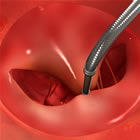
MitraClip® repairing
mitral
valve without surgery |
|
April 14, 2011 --
New Orleans -- Abbott (NYSE: ABT) today announced
data from its EVEREST II (Endovascular Valve Edge-to-Edge
REpair STudy) study showing that patients with significant
mitral regurgitation (MR) treated with the company's investigational
percutaneous catheter-based MitraClip® system continue to
demonstrate the clinical benefits of initial treatment shown
at one year out to two years, including improvements in heart
function and reductions in symptoms. EVEREST II is the first
randomized clinical trial to compare a catheter-based mitral
valve device to mitral valve surgery. Data from the study
were published in The New England Journal of Medicine and
presented in a late-breaking clinical trial session at the
American College of Cardiology's (ACC) 60th Annual Scientific
Session and i2 Summit 2011 in New Orleans.
|
At two years after treatment, data from 279 patients from the EVEREST II trial demonstrated a clinical success rate of 51.7 percent for patients treated with the MitraClip device compared to a clinical success rate of 66.3 percent for surgery patients (p=0.04) on an Intention-to-Treat (ITT) basis. These results compare with the one-year data, which demonstrated a clinical success rate of 55.2 percent for patients who received the MitraClip device, compared to a clinical success rate of 73.0 percent for surgery patients (p=0.0007). The clinical success rate is defined as freedom from death, from surgery for valve dysfunction, and from moderate to severe MR (3+ or 4+).
In The New England Journal of Medicine, the study authors, who represent
a variety of specialties including cardiac surgery and interventional
cardiology, state that "although percutaneous repair was less effective
at reducing mitral regurgitation than surgery before hospital discharge,
at 12 and 24 months the rates of reduction in mitral regurgitation
were similar, and percutaneous treatment was associated with increased
safety, improved left ventricular dimensions, and clinical improvements
in NYHA class and quality of life."

Ted Feldman,
MD
Evanston, Illinois
|
|
"These results reinforce that
the MitraClip device continues to be effective out to two years,
confirming the durability of the clinical benefit and the safety
profile of the therapy. Surgery also performed well in the trial," said
Ted Feldman, M.D., FSCAI, director, Cardiac Catheterization Laboratory,
and The Mr. and Mrs. Charles R. Walgreen Chair in Interventional
Cardiology, NorthShore University HealthSystem, Evanston, Ill. "The
MitraClip system offers an option that addresses the unmet need
for a percutaneous approach to treating MR, which may be especially
important for many patients who are considered high-risk surgical
candidates."
Dr. Feldman served as co-principal investigator
of the EVEREST II trial, was the lead author of the New England
Journal of Medicine publication, and presented the two-year
EVEREST II data during the late-breaking clinical trial session
at ACC. |
"In the EVEREST II study, the MitraClip device demonstrated strong safety and meaningful clinical benefits," said Donald Glower, M.D., professor of surgery, Cardiovascular and Thoracic Surgery Division, Duke University School of Medicine, Durham, N.C., co-principal investigator of the EVEREST II trial and an author of the New England Journal of Medicine publication. "The
MitraClip system's positive risk-benefit profile supports its use as
a treatment choice for patients who are not good candidates for surgery
and have few other options, including elderly or frail patients, those
who are at high risk for surgery, and certain patients with functional
MR."
The MitraClip system includes a catheter-based device that is delivered to the heart through the femoral vein, a blood vessel in the leg. The MitraClip therapy is designed to reduce significant MR by clipping together the leaflets of the mitral valve, one of the four valves of the heart.
The most common type of heart valve insufficiency,1 MR affects more
than 4 million people in the United States – a prevalence of 11.7 percent
of those aged 75 years and older.2 Significant MR is a debilitating
condition in which the heart's ability to function continues to deteriorate
over time and may lead to irregular heartbeats, heart failure, stroke,
heart attack or death. The condition traditionally has been managed
with medications (which can relieve symptoms but do not address the
underlying cause of the condition) or open-heart surgery. Many people
who suffer from MR are not treated surgically3 because they are not
referred to surgery, are not sick enough, or are too frail for an invasive
procedure.
EVEREST II Data Demonstrate Durability Through Two Years
The EVEREST II pivotal trial is a multi-center, randomized clinical trial of 279 patients in the United States and Canada with moderate-to-severe (3+) or severe (4+) MR who were candidates for mitral valve surgery.
In addition to the clinical success rate at one and two years, data from the EVEREST II study showed the following on an ITT basis:
- At 30 days, the MitraClip system demonstrated
superior safety compared to surgery, with 15.0 percent of MitraClip
patients and 47.9 percent of surgery patients experiencing a
major adverse event (MAE) (p<0.001). Major adverse events are
defined as a composite of 12 pre-specified adverse events.
- At
one and two years, both the MitraClip and surgery groups experienced
a significant reduction (p<0.05)
in the end systolic and end diastolic volume of the left ventricle
heart chamber compared to baseline, indicating an improvement
in heart function.
In both groups, the decrease in end diastolic volume that was observed
between baseline and one year continued to decrease between years one
and two.
- Both the MitraClip device and surgery
experienced a statistically significant reduction in New York
Heart Association (NYHA) Functional
Class symptoms at one year that was sustained through two years.
NYHA Functional Class provides a scale that assists in the determination
of functional ability in patients with heart disease.
- At two
years, 78 percent of patients randomized to the MitraClip device
were free from surgery.
Longer-term follow-up of patients in EVEREST
II is planned and will provide additional data to better understand
the benefits of the MitraClip device.
Two-year results from patients with functional MR and patients considered
at high risk for mitral valve surgery were also featured in presentations
at ACC. Results from both presentations demonstrated that positive
one-year clinical outcomes were sustained out to two years.
"The publication of the EVEREST
II data in the New England Journal of Medicine and today's data
presentation at ACC represent significant milestones in a nearly
decade-long effort to develop a new treatment option for patients
with mitral regurgitation," said Charles A. Simonton, M.D., FACC,
FSCAI, divisional vice president, Medical Affairs, and chief
medical officer, Abbott Vascular.
"Nearly 3,000 patients around
the world have now been treated with the MitraClip device. We
look forward to an FDA Advisory Panel to review the safety and
effectiveness of the MitraClip device this year, hopefully bringing
the technology a step closer to being available to U.S. physicians
and patients." |
|

Charles
A. Simonton, MD |
About Mitral Regurgitation (MR)
MR occurs when the leaflets of the mitral valve do not close completely, causing
blood to flow backwards and leak into the left atrium of the heart during the
cardiac cycle. To maintain an adequate forward flow of blood throughout the
body, the heart compensates by increasing the size of the left ventricle (the
main pumping chamber of the heart) to accommodate the increase in the volume
of blood it is pumping. The chronic volume overload caused by MR requires the
heart to work harder and may ultimately lead to heart failure and other complications.
MR traditionally has been managed with drugs or open-heart surgery, depending
on an individual patient's severity of MR and risk factors.
About the MitraClip Technology and Procedure
Abbott's proprietary MitraClip system is designed to reduce significant MR
by clipping together the leaflets of the mitral valve, one of the four valves
of the heart. The catheter-based MitraClip device is delivered to the heart
through the femoral vein, a blood vessel in the leg. The heart beats normally
during the procedure, and therefore does not require a heart-lung bypass machine.
After treatment, patients are usually home within two to three days and have
been observed to recover quickly. The safety and efficacy of the MitraClip
system were evaluated in EVEREST II, a study supported by Abbott.
The MitraClip system received CE Mark in March 2008 and is commercially available
in Europe, Turkey, Israel and Australia. The first-in-man clinical trial of
the MitraClip system was conducted in the United States, where it is an investigational
device currently under review for approval by the U.S. Food and Drug Administration.
About Abbott Vascular
Abbott Vascular is a global leader in cardiac and vascular care with market-leading
products and an industry-leading pipeline. Abbott Vascular offers a comprehensive
cardiac and vascular devices portfolio, including products for coronary artery
disease, vessel closure, endovascular disease, and structural heart disease.
About Abbott
Abbott (NYSE: ABT) is a global, broad-based health care company devoted to
the discovery, development, manufacture and marketing of pharmaceuticals and
medical products, including nutritionals, devices and diagnostics. The company
employs nearly 90,000 people and markets its products in more than 130 countries.
1 Nkomo VT, Gardin JM, Skelton TN, Gottdiener
JS, Scott CG, Enriquez-Sarano M. Burden of valvular heart diseases:
a population-based study. Lancet. 2006 Sep 16; 368(9540):1005-11.
2 Ibid.
3 Bach DS, Awais M, Gurm HS, et al. Failure of guideline adherence for
intervention in patients with severe mitral regurgitation. J Am Coll Cardiol
2009; 54:860-865.
Source: Abbott
Vascular
|
|