|
|
|
October
5,
2011 -- 12:10pm EDT In
Memoriam: J. Willis Hurst, MD
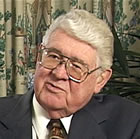
J. Willis Hurst,
MD
(1920-2011)
|
Sad news out of Atlanta that
Dr. J. Willis Hurst passed away on October 1 after a brief illness,
a few weeks short of his 91st birthday. Hurst was a
major figure in cardiology worldwide, having served as Professor
and Chairman of the Department
of Medicine
at the Emory University School of Medicine for 30 years, and
the
author of "Hurst's
The Heart", undisputedly the "bible" of cardiology,
which is in its 13th edition and has been translated into more
than five languages. It is considered to be the most widely used
cardiology
textbook in the
world. I
know
that
every cardiologist's office I've ever been in (and that's a lot)
has "Hurst's The Heart" prominently displayed on the
bookshelf.
Above all he was a teacher. Countless cardiologists went through his classes
at Emory and he shaped the views and outlook of many thousands of
physicians. You can read more about Dr. Hurst in a
letter from his colleagues, posted on the Emory website. He was a Fellow
of Dr. Paul Dudley White, considered the founder of American
academic cardiology, and Hurst served as President Lyndon Johnson's
personal cardiologist for 18 years.
But Hurst also had a hand in fostering what became a
revolution in cardiology.
Back in 1979, Emory cardiologist
Dr. Spencer B. King, III traveled to Zurich to attend
the early courses of Dr. Andreas Gruentzig
to learn about his controversial new procedure called "percutaneous
transluminal coronary angioplasty". King befriended Gruentzig who
expressed his concern that, unless he could keep control over
the spread of this
new procedure,
it could be destroyed, if it were
not done carefully.
Interest was growing rapidly and Gruentzig
was looking to move to the U.S. to establish a teaching center.
King suggested Emory and that is where Gruentzig landed. With significant
support from Emory and the Woodruff Health Center, Gruentzig
expanded
the live demonstration course and, from 1980-85 in Atlanta, he
personally trained the first wave of interventional cardiologists,
and established the professional, scientific and ethical benchmarks
of that subspecialty.
J. Willis Hurst, as Chairman of the Department, was instrumental
in meeting Gruentzig's needs, both academically and, well...check
out the short video
clip below. I had the honor of interviewing Hurst for
my documentary, "PTCA:
A History" and he told me what Gruentzig asked for in order to come
to Emory.
Video not loaded
|
J. Willis Hurst, MD
discusses bringing Andreas Gruentzig,
the inventor of coronary angioplasty,
to Emory (:55) |
|
|

|