The following article is an in-depth description
of Boston Scientific's Taxus Express² paclitaxel-eluting
coronary stent system. For background information
on this new type of device, read
our article on "Drug-Eluting
Stents". To
read what a leading interventional cardiologist says about drug-eluting
stents
and their impact
on patients, go
to our exclusive
interview with Gregg Stone,
MD. For the latest news about developments
in the field, go to our Drug-Eluting
Stent NewsCenter.
Components of the
TAXUS Express² Stent System On March 4, 2004, the U.S. Food and Drug
Administration (FDA) granted approval to the Boston Scientific's
Taxus Express² paclitaxel-eluting coronary stent system. The stent
has been available since January 2003 in Europe.
Taxus Express² paclitaxel-eluting
coronary stent
The stent system is
built on Boston Scientific’s Express² stent, a newer generation
device which has been used widely in bare metal stent cases since
its introduction in 2002. The Express² has been called highly “deliverable”,
meaning that its advanced design allows it to reach distant and
difficult lesions in the coronary anatomy more easily. As with
all stents, a balloon is advanced, under fluoroscopy, to the narrowing
(or lesion) in the coronary artery
To create the Taxus stent, the Express²
is coated with a special polymer, a hydrocarbon-based elastomer,
called TransLute™, in which the drug paclitaxel (PAK-lih-tacks-el)
has been embedded. The polymer is formulated to allow very specific
time-release of the drug. (In fact, the clinical trials utilized
both a slow-release and a moderate-release version to determine
which dosages worked best.)
What is Paclitaxel? Paclitaxel is a naturally-occurring compound
that was found in the bark of the Pacific Yew Tree (Taxus brevifolia)
when the National Cancer Institute screened thousands of plant
species as possible anti-cancer agents during the 60’s
and 70’s. Paclitaxel is the active ingredient in the widely-used
chemotherapy drug Taxol™.
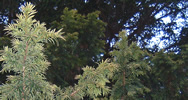
Pacific
Yew Tree
cellular microtubules (artist's rendition)
The drug works by binding
to parts of the cell, called microtubules, and interrupting
the biochemical signaling
process that causes
cell migration and accumulation. In large doses, it has significant
anti-tumor properties -- it prevents unwanted cells from growing.
However, in smaller time-release doses, such as those eluted
by the Taxus
stent,
paclitaxel takes on more anti-inflammatory
characteristics; that is to say, the drug seems to have the
effect
of regulating, but not completely eliminating, cell accumulation.
This characteristic is
important in striking a crucial balance. While significant accumulation
of cells around and inside the stent can clog the interior channel
and cause restenosis, some cell accumulation is desirable
because allowing a thin layer of endothelial cells to accumulate
on the inside of the implanted stent forms a smooth cover, incorporating
the device into the artery itself. This process is called endothelialization
and is important in preventing the complication of thrombosis
(blood cells reacting to a foreign object by clotting and blocking
the artery).
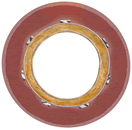
Endothelium covers stent
in artery (cross section)
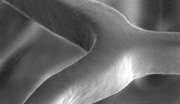
electron microscope view of Taxus Express² polymer coated stent
Why
a Polymer Coating? First of all the TransLute™ polymer
serves to hold the drug securely on the stent. An earlier coated
stent, manufactured by Guidant/Cook, also used paclitaxel, but
not in a polymer -- the stent was just dipped in the drug. The
device did not perform much better than bare metal stents, and
it was thought that some of the drug was lost before the stent
was ever inserted in the patient.
Additionally the proprietary
polymer used on the Taxus allows precise control over the dosage
and time-release characteristics
for paclitaxel, permitting elution of a sufficient amount of the
medication to inhibit cell accumulation around the
stent
and
prevent restenosis,
yet still allow a thin cover to form. Importantly
this low and very localized dosage does not impact the patient
adversely the way
that a high dosage systemic course of chemotherapy would.
Clinical Trial Results In order to test the three-way combination
of the Express² stent, the time-release polymer coating and the
anti-inflammatory drug
paclitaxel, a series of clinical trials were initiated to measure
the safety and effectiveness of the system. The trials compared
patients who received the Taxus stent with those who received the
Express² bare metal stent; the trials were double-blinded -- neither
the physicians nor patients knew which stent they had. The TAXUS-IV
nine-month results
were reported
at the TCT meeting in September 2003 and are summarized as follows:
Over 1300 patients in 73 centers took
part
Combined MACE (Major Adverse Cardiac
Events – repeat intervention
with angioplasty or surgery, heart attack, death)
was reduced from 15% in the control group to 8.5% in the Taxus
group – a
reduction of 43%
In-stent restenosis (where a blockage
recurred inside the stent) went from 24.4% down to 5.5% -- a
77% reduction
Diabetics, a subgroup typically at high risk
for restenosis, experienced even higher rates of restenosis reduction,
with those on insulin going
from 42.9% to 7.7% and those on oral meds from 29.7% to 5.8% -- approximately
22% of those studied were diabetics
TLR (Target Lesion Revascularization – whether
a specific blockage that was stented needed to be reopened, either
through
angioplasty
or surgery) went from 11.3% down to 3% -- a 73% reduction
TVR (Target Vessel Revascularization – whether
a blockage anywhere in the target artery needed to be reopened)
went from 12% to 4.7%
-- a 61% reduction (this was the primary endpoint
of the trial because it measures the total effect of implanting
a stent
in the artery)
Stent thrombosis (clotting) was similarly low (less than 1%)
for both Taxus and control groups
Complete results of the study can be found here,
but the benefits of the Taxus drug-eluting stent are quite apparent.
The FDA has
asked Boston Scientific to continue its tracking of patients who
receive the Taxus in a study that will enroll 2,000 patients.
More
information on the Taxus stent can be found at the manufacturer's
web site www.taxus-stent.com.
send comments & suggestions
to "info at angioplasty dot org"
Read our Privacy statement.
Angioplasty.Org is an editorially independent informational health
site
which has received unrestricted educational grants from Medtronic plc,
TCROSS NEWS, Toshiba
America
Medical Systems, Volcano
Corporation, Terumo
Medical Corporation
Cardium Therapeutics, Inc. and Lenox Hill Heart and Vascular Institute of NY