

|
|
|
| History of Angioplasty Timeline |
This brief timeline is intended to
give an overview of the history of interventional cardiology.
More in-depth information can be accessed through the links
provided, as well as from the reference
sources listed at the bottom of the page.
- 3000 B.C. — Egyptians
perform bladder catheterizations using metal pipes.
- 400 B.C. — Catheters
fashioned from hollow reeds and pipes are used in cadavers
to study the function of cardiac valves.
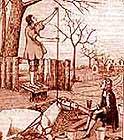
- 1711 — Hales
conducts the first cardiac catheterization
of a horse using brass pipes, a glass
tube and the trachea of a goose.
|
- 1844 — French physiologist
Bernard coins the term "cardiac catheterization" and
uses catheters to record intracardiac pressures in animals.
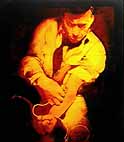
- 1929 — First
documented human cardiac catheterization
is performed by Dr.
Werner Forssmann in Eberswald, Germany. (Click
to see video)

|
- 1941 — Cournand and Richards
employ the cardiac catheter as a diagnostic tool for
the first time, utilizing catheter techniques to measure
cardiac output.
- 1956 — Forssmann,
Cournand and Richards share the Nobel Prize.
Cournand states in his acceptance speech "the
cardiac catheter was...the key in the lock."
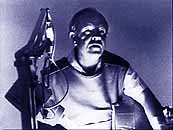
- 1958 — The
diagnostic
coronary angiogram — the
key to selective
imaging of
the heart is
discovered
by Dr.
Mason Sones
|
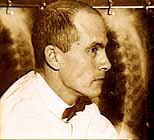
- 1964 — Transluminal
Angioplasty, the concept of remodeling the artery,
is introduced by Dr.
Charles T. Dotter
|
- 1967 — Dr. Rene Favaloro
conducts first saphenous vein graft (bypass) surgery
in Cleveland
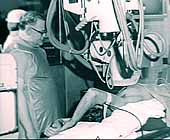
- 1967 — Introduction
of the Judkins
Technique of coronary angiography
|
- 1974 — Andreas
Gruentzig performs first peripheral human balloon
angioplasty
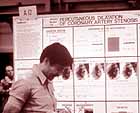
- 1976 — Gruentzig presents
results of animal studies of coronary angioplasty
at American Heart Association meeting
|
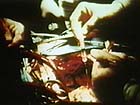
- 1977 — First human coronary
balloon angioplasty performed intraoperatively by Gruentzig,
Myler and Hanna in San Francisco
|
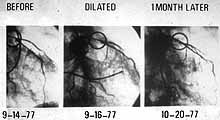
- 1977 — Andreas
Gruentzig performs first cath lab PTCA on awake
patient in Zurich; starting with this case, all PTCA
data is entered into a worldwide registry
|
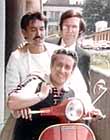
- 1978 — First PTCA cases
performed in America by Myler in San Francisco and
Stertzer in New York; Gruentzig conducts
first demonstration course in Zurich, Switzerland,
attended by 28 pioneering physicians; International
Dilatation Society is established
|
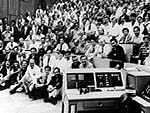
- 1980 — Gruentzig conducts
the last of five demonstration courses in Zurich with
Sones, Judkins and Dotter in attendance; he then moves
to Atlanta, GA where be becomes Director of Interventional
Cardiology at Emory University; National Heart, Lung & Blood
Institute begins support of the existing PTCA registry;
first 1000 angioplasties are performed worldwide; guiding
catheters are introduced
- 1982 — over-the-wire
coaxial balloon systems introduced,
brachial guiding catheters & steerable
guide wires are developed
- 1985 — A
year of loss in the history of interventional
medicine: Dotter, Sones, Judkins and
Gruentzig all pass away nine months
of each other; Gruentzig dies in a
plane crash on Sunday night, October
27; on Monday, October 28, Richard
Schatz, co-inventor of the Palmaz-Schatz
stent, has an appointment to meet with
Gruentzig
- 1986 — coronary
atherectomy devices are introduced;
Jacques Puel and Ulrich Sigwart implant
the first coronary Wallstents in Toulose,
France
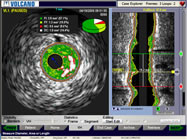
- 1987-1993 — a
large number of new interventional
devices are invented and perfected;
some, like lasers, are less effective
than hoped for; others are approved
and used worldwide; these devices include
rotational atherectomy devices (Rotablator), intravascular ultrasound (IVUS) and
stents
|
- 1994 — the Palmaz-Schatz
stent is approved by the F.D.A. for use in the United States
- 1994-1997 — stents become
commonplace and eliminate many complications
- 1997 — over one million
angioplasties will be performed worldwide, making angioplasty
the most common medical intervention in the world
- 2001 — almost two million
angioplasties were performed worldwide, with an estimated
increase of 8% annually
- 2002 — the 25th anniversary
of the first angioplasty performed in an awake patient
- 2003 — the first
drug-eluting stent, the Cypher, manufactured by Johnson & Johnson
/ Cordis, is approved by the F.D.A., marking a major
advance in the battle to reduce restenosis to single
digits
- 2004 — Boston
Scientific gets its Taxus drug-eluting stent approved;
many studies are published demonstrating the vastly improved
outcomes from drug-eluting stents
References — For
further information on the history of PTCA, we recommend the
following articles:
- Mueller R. and Sanborn T.
- The History of Interventional
Cardiology, Am Heart J 1995;129:146-72
 
- Myler R., Stertzer, S.
- Coronary and Peripheral Angioplasty:
Historic Perspective, Textbook of Interventional
Cardiology (2nd Ed.) Vol. 1. Topol, E. (Ed.) WB
Saunders Co., Philadelphia,1993
 
- King, S.B.
- Angioplasty From Bench to Bedside
to Bench, Circulation 1996;93:1621-1629
BACK TO TOP
OF PAGE |
|
|

