|
FDA Makes Recommendations on Medical Devices That Treat Blocked Heart Arteries
|
 |
March 26, 2008 -- U.S. Food and Drug Administration
Commissioner Andrew C. von Eschenbach today announced that the agency
has issued draft guidelines to aid the development, testing and manufacture
of coronary drug-eluting stents, devices used to treat blocked heart
arteries.
Over the past few years, FDA and the clinical
community have been closely monitoring these devices, including
concerns over
clot formation in some patients
several years after implantation. The draft guidelines issued today -- called
an FDA guidance document -- outline
the agency's recommendations for pre-market clinical evaluation and post-market
studies, which may provide data to better address this and other potential safety
concerns.
Each year in the United States, approximately one million patients
undergo procedures
to treat coronary atherosclerosis, also known as hardening or blockages of
the heart arteries, a condition that can cause angina and heart attacks.
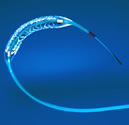
Taxus Drug-Eluting
Stent,
courtesy Boston Scientific
|
|
Some 650,000 of these patients
are treated with drug-eluting stents, a scaffolding device that
is placed into the arteries to prop them open. Drug-eluting stents
have a coating that slowly releases a drug to prevent the growth
of scar tissue that may accumulate after the initial procedure
opens the artery.
Re-accumulation of scar tissue can mean additional
procedures to keep arteries open and preserve adequate blood
flow. |
"This draft guidance is part of FDA's ongoing effort to provide regulated industry with recommendations on measures that can minimize the risks while preserving for patients the benefits of drug-eluting stents," said
Daniel G. Schultz, M.D., director of FDA's Center for Devices and Radiological
Health.
This draft guidance, announced in today's Federal Register, http://www.gpoaccess.gov/fr/index.html,
discusses the development pathway for new drug-eluting stents and provides recommendations
on information necessary for a complete marketing submission. It also provides
guidance on assessing the toxicity of the drug used to coat the stent, both on
its own and as part of the complete product. Because these stents combine device
and drug technology, this guidance contains expertise and input from two agency
centers—the Center for Devices and Radiological Health and the Center for Drug
Evaluation and Research.
Also included are draft recommendations for engineering tests, biocompatibility tests, and animal studies to assess the device's overall safety.
"This guidance demonstrates how FDA will need to work across traditional product boundaries to guide the development of innovative new products," said
Janet Woodcock, M.D., director of FDA's Center for Drug Evaluation and Research.
Currently, FDA has approved three coronary drug-eluting stents.
A copy of the guidance, "Draft Guidance for Industry on Developing Coronary Drug Eluting Stents," can
be found at http://www.fda.gov/cdrh/ode/guidance/6255.html.
FDA is planning a public workshop on drug-eluting stents, in part as one means of soliciting comments on this guidance. The date, location and method for comment for this workshop will be announced in the Federal Register and on FDA's Web site, www.fda.gov.
FDA invites public comment on this draft guidance for 120 days from today's publication in the Federal Register.
Typed comments should include the docket number (CD6255), and be sent to:
Division
of Dockets Management (HFA-305)
Food and Drug Administration
5630 Fishers Lane
Room 1061
Rockville, MD 20852
To submit comments via the Internet --
go to: http://www.regulations.gov/search/index.jsp
Type in the docket number (CD6255),
and follow instructions for
comment submission.
Source: U.S. Food and Drug Administration
|