|
Circulation Publishes Pivotal Two-Year Results On XIENCE V™ Drug Eluting Stent
Data from SPIRIT III Trial Demonstrate that Patients Treated with XIENCE V Are Less Likely to Have a Heart Attack or Require a Repeat Intervention Out to Two Years
|
 |
January 28, 2009 -- Abbott Park,
Illinois -- Data published online today in Circulation
from the SPIRIT III U.S. pivotal trial evaluating the XIENCE
V™ Everolimus Eluting Coronary Stent System demonstrated that
Abbott's market-leading XIENCE V outperforms the TAXUS® Express²™ Paclitaxel-Eluting
Coronary Stent System (TAXUS) in reducing major adverse cardiac events
(MACE) at two years.
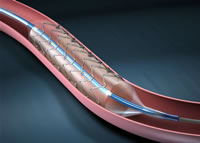
XIENCE V™ Everolimus
Eluting
Coronary Stent System |
|
In the SPIRIT III trial of
1,002 patients, XIENCE V demonstrated a 45 percent reduction
in the risk of MACE, and a 40 percent reduction in the risk of
cardiac death or heart attack (myocardial infarction, or MI)
at two years in patients treated with XIENCE V compared to those
treated with TAXUS. Additionally, at two years the study demonstrated
a 32 percent reduction in the risk of target vessel failure (TVF,
cardiac events related to the treated vessel) for XIENCE V compared
to TAXUS.
These published results were first presented in May
2008 at the EuroPCR Congress in Barcelona. |
"As published in Circulation, the SPIRIT III study results demonstrate that the clinical benefits of XIENCE V continue to improve between one and two years of follow-up after stent implantation compared to TAXUS," said Gregg W. Stone, M.D., Columbia University Medical Center; chairman, Cardiovascular Research Foundation, New York; and principal investigator of the SPIRIT III trial. "These
data reinforce our earlier findings demonstrating the excellent angiographic
and clinical results with the XIENCE V stent, resulting in fewer heart
attacks and repeat reinterventions."
The SPIRIT III trial demonstrated the following
key results for XIENCE V at two years:
- A 45 percent reduction in the risk of
MACE compared to TAXUS (7.3 percent for XIENCE V vs. 12.8 percent
for TAXUS,
p-value=0.004)*. MACE is an important composite clinical measure
of safety and efficacy outcomes for patients, defined as cardiac
death,
MI or ischemia-driven target lesion revascularization (TLR driven
by lack of blood supply).
- A 40 percent reduction in the risk
of cardiac
death or MI (4.0 percent for XIENCE V vs. 6.6 percent for TAXUS,
p-value=0.08)*.
- A 32 percent reduction in the risk of
TVF compared to TAXUS (10.7 percent
for XIENCE V vs. 15.4 percent for TAXUS, p-value=0.04)*. TVF
is a composite clinical measure of safety and efficacy outcomes
defined as cardiac
death, MI or target vessel revascularization (TVR).
- TAXUS (4.3
percent for XIENCE V vs. 6.9 percent for TAXUS, p-value=0.07)*.
- Low
rates of stent thrombosis (blood clotting within the treated
area)
per the Academic Research Consortium (ARC) definition of definite/probable
stent thrombosis (1.3 percent for XIENCE V vs. 1.7 percent
for TAXUS) and per the SPIRIT III protocol (1.0 percent for XIENCE
V vs. 1.7 percent
for TAXUS). The ARC definitions of stent thrombosis were developed
to eliminate variability in the definitions across various
drug
eluting stent trials.
- Among patients who discontinued anti-platelet
therapy
with a thienopyridine (clopidogrel or ticlopidine) in the study
after six months, trends showed that patients treated with
XIENCE V experienced
fewer stent thromboses compared to those treated with TAXUS
at the end of two years (0.4 percent for XIENCE V vs. 2.6 percent
for TAXUS).
"XIENCE V continues to demonstrate sustained excellence, and the data demonstrate why it is an important advancement in the treatment of heart disease," said Charles A. Simonton, M.D., FACC, FSCAI, divisional vice president, Medical Affairs, and chief medical officer, Abbott Vascular. "The
consistent positive clinical trial findings, like those from SPIRIT
III, are key contributors to why physicians have quickly adopted
XIENCE V, making it the market-leading drug eluting stent in the
United States
and in key markets around the world."
About the SPIRIT III Trial
SPIRIT III is a prospective, multi-center, randomized, single-blind, controlled clinical trial comparing XIENCE V to TAXUS in 1,002 patients (669 XIENCE V patients, 333 TAXUS patients) with either one or two de novo native coronary artery lesions. The trial was conducted across 65 academic and community-based centers in the United States between June 22, 2005, and March 15, 2006.
The primary endpoint of the SPIRIT III trial was in-segment late loss at eight months, wherein XIENCE V demonstrated superiority to TAXUS with a statistically significant 50 percent reduction in late loss (mean, 0.14 mm for XIENCE V vs. 0.28 mm for TAXUS). In-segment late loss is a measure of vessel renarrowing. In the co-primary endpoint of TVF at nine months, XIENCE V demonstrated statistical non-inferiority compared to TAXUS with an observed 20 percent reduction in TVF (7.2 percent for XIENCE V vs. 9.0 percent for TAXUS).
Additionally, in the pre-specified secondary endpoint of MACE, XIENCE V demonstrated a 43 percent reduction at nine months (4.6 percent for XIENCE V vs. 8.1 percent for TAXUS) and a 42 percent reduction in MACE at one year (6.0 percent for XIENCE V vs. 10.3 percent for TAXUS) compared to TAXUS.
About XIENCE V
XIENCE V is used to treat coronary artery
disease by propping open a narrowed or blocked artery and releasing
the drug,
everolimus, in a controlled manner to prevent the artery from becoming
blocked again following a stent procedure. XIENCE V is built upon Abbott's
market-leading bare metal stent, the MULTI-LINK VISION® Coronary Stent
System. The VISION platform is designed to facilitate ease of delivery,
making it easier for physicians to maneuver the stent and treat the
diseased portion of the artery.
The XIENCE V stent is available on both over-the-wire (OTW) and rapid exchange (RX) delivery systems. Rapid exchange is the most widely used type of delivery system because it provides physicians additional flexibility to work as single operators during stent procedures.
XIENCE V was approved by the U.S. Food and Drug Administration and launched in July 2008, and was launched in Europe and other international markets in October 2006. XIENCE V is an investigational device in Japan and is currently under review by the Ministry of Health, Labour and Welfare and the Pharmaceuticals and Medical Devices Agency.
Abbott also supplies a private-labeled XIENCE
V to Boston Scientific called the PROMUS™ Everolimus-Eluting Coronary
Stent System. PROMUS is manufactured by Abbott and supplied to Boston
Scientific as part of a distribution agreement between the two companies.
Everolimus, developed by Novartis Pharma AG, is a proliferation signal inhibitor, or mTOR inhibitor, licensed to Abbott by Novartis for use on its drug eluting stents. Everolimus has been shown to inhibit in-stent neointimal growth in the coronary vessels following stent implantation, due to its anti-proliferative properties.
Additional information about XIENCE V, including important safety and effectiveness information, is available online at www.xiencev.com.
About Abbott Vascular
Abbott Vascular, a division of Abbott, is one of the world's leading vascular care businesses. Abbott Vascular is uniquely focused on advancing the treatment of vascular disease and improving patient care by combining the latest medical device innovations with world-class pharmaceuticals, investing in research and development, and advancing medicine through training and education. Headquartered in Northern California, Abbott Vascular offers a comprehensive portfolio of vessel closure, endovascular and coronary products.
About Abbott
Abbott (NYSE: ABT) is a global, broad-based health care company devoted
to the discovery, development, manufacture and marketing of pharmaceuticals
and medical products, including nutritionals, devices and diagnostics.
The company employs more than 68,000 people and markets its products
in more than 130 countries.
Source: Abbott |