|
|
|
|
The following article provides an overview of drug-eluting
stents (a.k.a "drug coated stents" or "medicated
stents" or "DES") which gives a basic
understanding of the history and mechanisms of these
devices
For more in-depth information and late-breaking articles
about drug-eluting stents, visit our Drug-Eluting
Stent Center.
|
|
|
|
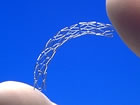 typical coronary stent
from the early 90's |
|
A
Brief History of Stenting
The concept
of the stent grew directly out of interventional
cardiologists' experience with angioplasty
balloons in the first decade of use (1977-87).
Sometimes the wall of the coronary artery
became weakened after balloon dilatation.
Although the artery would be opened successfully
using a balloon, in a small percentage
of cases, the artery would collapse after
the balloon was deflated -- sometimes this
might not happen until the patient had
been moved to the recovery room. Since
there was no interventional "fix" available,
the only option for this patient was emergency
bypass graft surgery to repair the problem. |
|
The Dilemma of Restenosis
A second problem soon
became evident as well. 30-40% of all coronary arteries
began to close up again after balloon angioplasty.
By the mid-80's various radiologists and cardiologists
were working on solutions to these problems, designing
new devices in hopes they would provide more safety
and durability to the procedures. Lasers, tiny "shavers",
rotational "polishers" -- many tools were
miniaturized to be delivered via catheter.
|
|
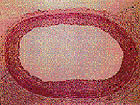 cross section of
restenosed artery |
|
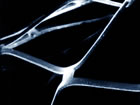
Close-up of early
Palmaz-Schatz stent
|
|
The First
Stents
One such
device was the stent -- a metal tube
or "scaffold" that was inserted
after balloon angioplasty. The stent
itself was mounted on a balloon and
could be opened once inside the coronary
artery. Julio Palmaz and Richard Schatz
were working on such a stent in the
United States; others in Europe were
developing their own designs. In 1986,
working in Toulouse, France, Jacques
Puel and Ulrich Sigwart inserted the
first stent into a human coronary artery.
In 1994 the first Palmaz-Schatz stent
was approved for use in the United
States. Over the next decade, several
generations of bare metal stents were
developed, with each succeeding one
being more flexible and easier to deliver
to the narrowing.
|
|
A Persistent
Problem
But while
stents virtually eliminated many of
the complications of abrupt artery
closure, restenosis persisted. Although
the rates were somewhat lower, bare
metal stents still experienced reblocking
(typically at six-months) in about
20-25% of cases, necessitating a repeat
procedure. The interventional cardiology
community also learned that restenosis,
rather than being a recurrence of coronary
artery disease, actually was the body's
response to what Andreas Gruentzig
called the "controlled injury" of
angioplasty and was characterized by
growth of smooth muscle cells -- roughly
analogous to a scar forming over an
injury.
|
|
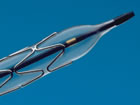 Close-up of stent
mounted on a balloon, circa 1995
Close-up of stent
mounted on a balloon, circa 1995 |
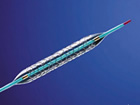 A drug-eluting stent,
circa 2002 |
|
Development
of Coated and Drug-Eluting Stents
More
and more, the solution moved away from
the purely mechanical devices of the
90's and toward pharmacologic advances
that were being made. If interventional
medicine, using the body's circulatory
system as a "highway" to
deliver therapy, worked with devices,
it could also work with medicines.
Physicians and companies began testing
a variety of drugs that were known
to interrupt the biological processes
that caused restenosis. Stents were
coated with these drugs, sometimes
imbedded in a thin polymer for time-release,
and clinical trials were begun.
|
Drug-Eluting Stent
Basics
Sometimes
referred to as a “coated” or “medicated” stent,
a drug-eluting stent is a normal
metal stent that has been coated
with a pharmacologic agent (drug)
that is known to interfere with
the process of restenosis (reblocking).
Restenosis has a number of causes;
it is a very complex process and
the solution to its prevention
is equally complex. However, in
the data gathered so far, the drug-eluting
stent has been extremely successful
in reducing restenosis from the
20-25% range to single digits. There
are three major components to a
drug-eluting stent:
-
Type
of stent that carries the drug coating
-
Method
by which the drug is delivered (eluted)
by the coating to the arterial wall (polymeric
or other)
-
The
drug itself – how does it act in
the body to prevent restenosis?
|
|
|
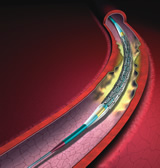 Artist's rendition
of coated stent on balloon in artery
Artist's rendition
of coated stent on balloon in artery |
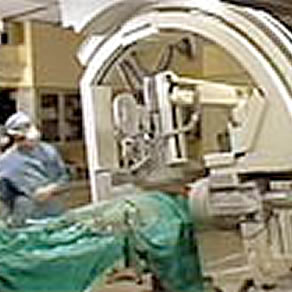
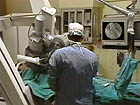 Interventional procedure
being performed in the catheterization lab
Interventional procedure
being performed in the catheterization lab |
|
In addition,
there are several decisions made by the interventional
cardiologist that result in a successful stent placement,
whether of the drug-eluting or bare metal variety:
- Correct sizing
of the stent length to match the length
of the lesion, or blocked area
- Correct sizing
of the stent diameter to match the thickness
of the healthy part of the artery
- Sufficient
deployment of the stent, making sure
that the stent,
once placed at the optimum site in the
blocked artery, is expanded fully to the
arterial wall – under-expansion can
result in small gaps between the stent
and arterial wall which can lead to serious
problems such as blood clots, or Sub-Acute
Thrombosis (SAT)
|
|
|
Usually the sizing and the assessments of expansion are made by
viewing the real-time angiogram in the cath lab, although some
cardiologists also are using more detailed information obtained
through intravascular ultrasound imaging.
Finally, in addition to aspirin, the patient must
take an anti-clotting or antiplatelet drug, such as
clopidogrel, prasugrel or ticlopidine (brand names
Plavix, Effient or Ticlid) for a year or more after
the stenting, to prevent the blood from reacting to
the new device by thickening and clogging up the newly
expanded artery (thrombosis). Ideally a smooth, thin
layer of endothelial cells (the inner lining of the
blood vessel) grows over the stent during this period
and the device is incorporated into the artery, reducing
the tendency for clotting.
|
|
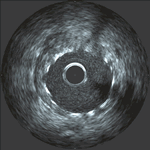 Intravascular ultrasound
image of stent in artery
Intravascular ultrasound
image of stent in artery |
|
|
|
"Stent
Wars"
The status
and availability of drug-eluting stents
have been the subject of many legal
disputes and other issue, which some
time ago Angioplasty.Org labeled "Stent
Wars". These devices were initially
adopted so quickly that they doubled
the world market for stents to $5 billion
annually. While usage of drug-eluting
stents was reduced immediately after
concerns over stent thrombosis first
surfaced in 2006, with further studies
showing increased efficacy and the
introduction of newer second and third
generation drug-eluting stents, DES
use is again increasing. Currently
in the U.S., the DES market is shared
by Abbott, Boston Scientific and Medtronic.
Cordis/J&J, manufacturer of the
CYPHER, the first FDA-approved DES,
was unable produce a second generation
device and so announced in 2011 that
it was ceasing production of the CYPHER
and dropping out of the stent market
entirely.
|
|
The newer drug-eluting stents
have thinner, more flexible struts, thinner and more
biocompatible polymers that elute the drug and, in
most randomized clinical trials and observational studies,
all show increased efficacy and safety: both the risks
of stent thrombosis and the rate of restenosis have
been reduced from the first generation devices.
Taking a different approach,
both Abbott and Germany-based Biotronik are testing
a completely bioabsorable stent which will totally
disappear after it has done its work. OrbusNeich received
CE mark approval in 2005 for its Genous stent which,
rather than using drugs to suppress excess tissue growth,
utilizes an bio-engineered coating to attract a thin "all-natural" endothelial
layer within hours. A number of other companies, such
as Biosensors, Stentys, etc, are working on other drug/polymer/stent
combinations.
The major positive for drug-eluting
stents is that all the approved devices have shown
significant reduction of restenosis in clinical trials
and in the "real world". DES have also shown
dramatic reduction in reinterventions in diabetics
as well -- this is a population that has been highly
susceptible to restenosis in the past.
Stent Thrombosis
There is some evidence
that drug-eluting stents may be susceptible to an
event known as "late stent thrombosis",
where the blood-clotting inside the stent can occur
one or more years post-stent, after the recommended
one-year of dual antiplatelet therapy has ended.
While this was seen infrequently in the first-generation
Taxus and Cypher stents, thrombosis is extremely
dangerous, fatal in over one third of cases. To prevent
thrombosis, a full course of post-stent antiplatelet
therapy is very important and patients should not
stop taking aspirin, Plavix, Effient or Ticlid without
consulting their interventional cardiologist.
The issue of late stent thrombosis,
although discussed within the profession since drug-eluting
stents were introduced, received widespread publicity
at the September 2006 World Congress of Cardiology
meeting in Barcelona when three European studies pointed
to higher rates than had previously been seen (see
our feature, "Problems
Resurface with Drug-Eluting Stents" for
detailed coverage). Late stent thrombosis was one of
the major issues discussed at the 2006 TCT Meeting
and the FDA scheduled a public meeting in early December
2006 on the issue. The conclusion was that more information
was needed, especially about the use of devices in
off-label settings, but that when used as directed,
there did not seem to be greater risks of death or
heart attack with drug-eluting stents.
However, within a short time,
newer second-generation drug-eluting stents came to
market and studies have shown the risk of late stent
thrombosis to be even lower. In fact the Swedish Stent
Registry (SCAAR) which reported great concerns over
stent thrombosis in 2006, has now shown the exact opposite,
with drug-eluting stents showing far great safety and
effectiveness than bare metal stents.
Developments in this field
can be fast and furious. Keep abreast of the constantly
changing status of clinical trial results and controversies
in our Drug-Eluting
Stent NewsCenter.
|
|
|
|
Outlook
for Patient Care
While
there continue to be questions about
the use (or overuse) of drug-eluting
stents vs. medical therapy alone, and
which is the best stent, the development
of these sophisticated devices and
the new wave of treatment options are
further expanding the tools of cardiologists.
The durability of interventional procedures
to treat coronary artery disease non-surgically
has increased exponentially with the
introduction of drug-eluting stents.
The specter, possible complications
(and expense) of repeat procedures,
will be vastly reduced. And diabetics,
a patient population that previously
has not seen great success with angioplasty
and stent procedures, can now be treated
with more confidence.
|
|
| |
|
|