
<< To Homepage >>
<<Archives>>
March 2011 Archives:
March 29, 2011 -- 4:30pm EDT Will a Heart Stent from the Wrist RIVAL
One from the Leg?
It's an approach that is used 50% or more of the time in other countries, but is still in the single digits (pun intended) here in the United States. You can read why the U.S. has been behind the curve in our many articles on the subject of the transradial approach. But all this soon may be changing, if the results of an important study, being presented at this year's American College of Cardiology meeting, support the investigators' hypothesis:
The study is dubbed RIVAL (RadIal Vs. FemorAL Access for Coronary Intervention Study) and, as of last month, had enrolled over 7,000 patients. It's actually a sub-study of the CURRENT-OASIS 7 trial, which tested double-dose clopidogrel after PCI. But RIVAL will be looking at the incidence within 30 days of death, heart attack, stroke and non-CABG major bleeding in Acute Coronary Syndrome (ACS) patients who are experiencing unstable angina or heart attack (either NSTEMI or STEMI) and who are going to be treated with angioplasty and/or stents. Included in the definition of non-CABG major bleeding is access-site hemorrhage requiring intervention, retroperitoneal bleeding, where significant blood loss into the retroperitoneal space occurs, often undetected right away, large hematomas or any significant reduction in hemoglobin where there is no overt source of bleeding. And RIVAL will compare the 30-day results of those patients where femoral access was used vs. those who were treated via the transradial wrist approach.
Previous smaller studies have shown a significant reduction in bleeding complications with the transradial approach, and some have posited that mortality and bleeding complications are related. Speaking of complications, if you take a look at just two topics in our Patient Forum (Complications from Femoral Caths and Complications from Vascular Closure Devices) you'll find over 1,300 posts from patients who have suffered from bleeding complications with the femoral approach, not to mention trauma to the femoral nerve or complications from various vascular closure devices (which are not used in radial procedures). It's not that the femoral approach is terrible. Quite the contrary. Over 90% of patients do perfectly well with femoral caths -- and the radial approach is not possible in all patients. But when less than 7% of all procedures in the U.S. are done via the wrist, and the vast number of U.S. interventional cardiologists don't even know how to do radial procedures, something has to change. And on Monday morning, April 4, 2011, when the RIVAL results have been presented to the ACC/i2 Joint Session at ACC.11 in New Orleans, that change may well be accelerated. « permalink » « send comment » « back to top »
March 27, 2011 -- 8:22pm EDT Transradial Cath in Bakersfield
It's a good report because it not only interviews Dr. Tommy Lee, the interventional cardiologist who has started doing radial caths (about 100 so far) because he feels it is safer, but it has a couple patients talking about their experience. Dr. Lee states in the broadcast that he believes radial is the future of cardiac catheterization:
Of course, a cardiologist in Europe might look at this broadcast and smile, because transradial to a European cardiologist (or a Chinese, Japanese or Indian cardiologist) is neither new nor revolutionary -- in OUS (Outside the United States) the transradial approach is used 40-50% of the time. Many cardiologists use it 90%. It's just that it has taken a long time for this approach to be accepted in the U.S. (You can read all about this in Angioplasty.Org's Transradial Center.) But this technique, first described in 1989 by Montreal cardiologist Dr. Lucien Campeau, finally is catching on in the U.S. -- the chief advantages are reduction in bleeding complications, comfort for the patient and cost-savings for the healthcare system (since the complications are lower and patients can be safely discharged the same day). BTW, a shout-out to Cindy Welch, whose blog "Designs from the Heart" is where I first saw this interview. « permalink » « send comment » « back to top »
March 23, 2011 -- 6:50pm EDT Smoking After Sex: A Double Heart Attack
Risk?
It's not exactly a new thought. Back in 2004, we linked to this New York Times article which reported on a 1996 study; it basically came to the same conclusions. But two Tufts researchers looked at 14 studies in the published medical literature and came up with statistical values that put a relative risk number on these activities. So (drum roll, please...) episodic physical activity increased one's heart attack risk by 345% -- and episodic sexual activity increased it by 270%. Sounds scary, except that the authors emphasize that these risks are actually not high, because they are transient (occurring during or close to the activity) and "because exposure to physical and sexual activity is infrequent." (This study looked at 55-64 year-olds, so I'm not even gonna go there!) Because of these factors, the researchers also stated that the absolute risk increase for heart attack associated with 1 hour of additional physical or sexual activity per week was estimated as 2 to 3 per 10 000 person-years. Comforting. The most important finding, however, was that these risks were significantly reduced in people who normally had high levels of habitual physical activity (we would assume that includes sexual activity). On a serious note, these questions are of real concern to heart patients. Our Patient Forum gets queries like this one last weekend in our topic on "Angioplasty Recovery Period":
For Broken-Hearted and other patients, we recommend your cardiologist as the person to ask -- he or she has your records and knows your clinical health status and can make recommendations regarding both physical and sexual activity. As the research study states, the better shape you're in, the less the risk. For more information from the Tufts researchers, Drs. Issa J. Dahabreh and Jessica K. Paulus, check out the video below, courtesy of JAMA.
« permalink » « send comment » « back to top »
March 21, 2011 -- 4:40pm EDT Heart Stent Success Stories
I just wanted to share a patient's posting from earlier today on Angioplasty.Org's Patient Forum Topic titled, "Exercise, Sport, Physical Activity After Stent":
I've written about this before -- that our Forum often winds up serving as a kind of "complaint department" for people having problems after stents, angioplasty, angiograms, etc. And these types of posts are important because they allow patients to share stories and discover they are not alone with these issues. (Indeed, Angioplasty.Org's Forum Topics currently get over 30,000 views a month.) So it is always great to read posts like David's to remember that these medical procedures "can turn around our lives...". « permalink » « send comment » « back to top »
March 14, 2011 -- 6:55pm EDT Wrist Angioplasty Up-Close: New York Style
Tomorrow's case will be a 65-year-old man and the plan is to perform PCI of his distal Left Main and LAD obstructions using stents delivered via the radial approach. The case operator will be Dr. Shamin Sharma of Mount Sinai and the moderator Dr. Sameer Mehta of University of Miami Medical Center. Dr. Mehta's recent LUMEN-AMI program featured the use of the transradial approach in STEMI. You can read our exclusive interview with Dr. Mehta on Angioplasty.Org. And for patients who are trying to find an interventional cardiologist experienced in using the radial approach, check out Angioplasty.Org's Transradial Hospital Locator. « permalink » « send comment » « back to top »
March 9, 2011 -- 9:15pm EST Wanted: Marathoners with Stents, Pacemakers,
Heart Valves
For example, former honorary captain for this program is Alberto Salazar, a world-renown marathon champion. Salazar is 52 and in 2007 collapsed from sudden cardiac arrest. He was revived via CPR and received an implantable cardioverter-defibrillator (ICD) to treat arrhythmia. He continues to train runners and had three participating in the Beijing Olympics. He is "committed to spreading the word about running and living safely with a chronic health condition." As I've written before, I am always amazed by the people who continue their athletic activities after having a device implanted (most could outrun me with no difficulty -- but that's another story...). Our Forum Topic, "Exercise, Sport, Physical Activity After Stent", has the stories of scores of stent and heart patients who continue to run, ride horses, etc. We even recently connected with Kevin, an IronMan AAA stent graft athlete, who is continuing to train after receiving this life-saving device, although AAA Stent graft patients are not eligible for the Medtronic Marathon, at least not for now. Sorry, Kevin...but maybe next year! Anyway, we applaud the invitation to heart patients. So often, after people discover they have coronary artery disease, a significant and understandable depression can set in: they feel their lives are over. Studies confirm that depression itself is a risk factor for heart disease. So it's not just a PR event. It is clinically important -- efficacious, as we say in the medical field -- to see events like the Global Heroes Marathon. To apply or recommend someone to be a 2011 Medtronic Global Hero, visit medtronic.com/globalheroes. Good luck! |
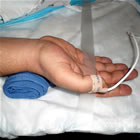 At
At 



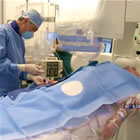 I'm
always keeping an eye on the growing number of news stories about
a "revolutionary new way to open the coronary arteries":
the transradial approach, that is, where the radial artery in the
wrist is used as the entry point for catheters, angioplasty balloons
and stents.
I'm
always keeping an eye on the growing number of news stories about
a "revolutionary new way to open the coronary arteries":
the transradial approach, that is, where the radial artery in the
wrist is used as the entry point for catheters, angioplasty balloons
and stents.  Okay.
Now that I have your attention....
Okay.
Now that I have your attention.... 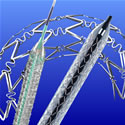
 For
physicians (and others) who are interested in seeing an advanced
PCI case using the transradial or wrist approach, tune in tomorrow
morning at 8:00am to this month's
For
physicians (and others) who are interested in seeing an advanced
PCI case using the transradial or wrist approach, tune in tomorrow
morning at 8:00am to this month's  Medtronic
(NYSE: MDT) has made its yearly
Medtronic
(NYSE: MDT) has made its yearly