
<< To Homepage >>
<<Archives>>
April 2011 Archives:
April 29, 2011 -- 10:55pm EDT Stent By Wrist in Houston In fact, the patient in this story had a stent placed via the wrist (radial approach) and then, due to a complication unrelated to the wrist, had to have another catheter procedure done through the groin (femoral approach). She reported that the wrist procedure was far more comfortable. And that's what is going to drive the adoption of the radial approach. As more and more patients find out about it, they will request, even demand it. Patients who are interested in finding a hospital that performs stent procedures from the wrist can use Angioplasty.Org's "Radial Hospital Locator" and also read the latest news, interviews with experts and overview articles about the transradial approach in our "Radial Access Center". « permalink » « send comment » « back to top »
April 26, 2011 -- 4:50pm EDT Wrist Angioplasty
in Indiana In my exclusive interview with Dr. Hall, he details how the transradial approach, currently utilized in only 5% of cases in the U.S., might be an answer to containing costs, or at least making procedures more cost-efficient -- mainly by reducing access-site bleeding complications. One such complication can end up costing the healthcare system a significant amount of money, not to mention, of course, the insult to the patient. How many patients go for a simple diagnostic catheterization, find out they have no coronary artery disease, but wind up with a femoral access site complication that ranges from merely inconvenient to very serious over the long term? Just read over the comments from Angioplasty.Org's Patient Forum Topics of "Complications After Femoral Angiogram or Angioplasty" -- all 700-plus of them. The Transradial Summit is a one day course, and it's happening this Saturday. You can register online. « permalink » « send comment » « back to top »
April 22, 2011 -- 7:10pm EDT Showdown: Dr. Mark Midei and Stents I've covered this particular issue previously ("Stent Accusations: The U.S. Senate Tries to Drum Up COURAGE"). In that article, Angioplasty pioneer, Dr. William O'Neill, who was hired by Midei's lawyer to review the cases...and found nothing glaringly wrong...posed a question to me, expressing his concern over the situation:
We will soon see if Dr. Midei's career gets reborn (you know, it's Spring, Easter weekend, bulbs and buds, etc. etc.) -- his licensure hearing is scheduled for Wednesday, April 27, before the Maryland Board of Physicians. In an interesting side-note, part of the response to these issues was that the Society for Cardiovascular Angiography and Interventions (SCAI) and the Maryland Chapter of ACC had pushed for a bill in the Maryland legislature that would set up a study group for accrediting cath labs and providing uniform protocols for decision-making about stents. Makes sense. But according to Reed Miller's report in theheart.org, that bill was nixed last week, due to the lobbying efforts of unnamed special-interest groups. To clarify: the ACC and SCAI represent cardiologists -- in other words the doctors' groups wanted to set up a system of oversight and they met resistance...from...??? Also, a shout out to Larry Husten who brought Dr. Midei's commentary to my attention on his blog Cardiobrief. « permalink » « send comment » « back to top »
April 8, 2011 -- 6:50pm EDT Transradial Wrist
Angioplasty RIVALs Femoral That may be changing as a result of an important study presented this week at the American College of Cardiology Annual Scientific Session (the 60th! -- Happy Birthday ACC -- in 5 years you can qualify for Medicare, assuming it still exists!) For a comprehensive review of the study, dubbed RIVAL (RadIal Vs. FemorAL Access for Coronary Intervention Study), read my article on Angioplasty.Org, "Angioplasty and Stenting from the Wrist Safe and Effective: The RIVAL Trial". There was some disappointment when the RIVAL results showed that one method was not superior to the other. You see, "radialists", as they call themselves, are very evangelical about the advantages of the wrist as the access site for diagnostic and interventional procedures. (They call those doctors who dismiss the wrist and are "addicted" to the leg, "femoral-holics".) So the title of this new study, RIVAL, is apt. The radial technique was first described in 1989 by Montreal cardiologist Dr. Lucien Campeau, but it's not been taught in medical schools or most fellowships in the U.S. so, while virtually all interventional cardiologists have been trained in the femoral approach (using the femoral artery in the upper leg/groin area) which has been around since it was perfected by Dr. Melvin Judkins in the 60's, hardly any knew how to utilize the wrist. Except a few pioneering cardiologists, like Dr. Tift Mann, or Dr. John Coppola who, after having a patient die from access-site bleeding complications after a successful angioplasty, decided to go to India and learn this technique from Dr. Tejas Patel. Dr. Coppola describes this journey in his exclusive interview in Angioplasty.Org's Transradial Access Center. That was less than a decade ago. Today things are different. Equipment is smaller, catheters are thinner and can go through smaller arteries, even a new stent (investigational in the U.S.) is called "a stent-on-a-wire", made by Svelte Medical. Imaging manufacturers are also getting into the act. Toshiba Medical just announced a new cath lab installation "optimized for the transradial approach". However, with new and very potent antithrombotic drugs that can help prevent clotting during interventional procedures, especially in STEMI, excess bleeding, especially at the catheter access site, has become a concern. Enter transradial: lower (or no) bleeding complications, increased patient comfort, because there is no need to lie still for hours, with heavy pressure on the femoral artery, or even need for a vascular closure device. And with smaller, thinner equipment, almost any complex procedure can be performed from the wrist. The only problem is very very few cardiologists can do a radial procedure. That too is changing, and I talk about that in my article too. So very soon, the joke Robin Williams tells about his heart procedure ("Who knew that the way to a man's heart was through his groin?") may be...well, he'll just have to work the wrist into it somehow.... ;-) « permalink » « send comment » « back to top »
April 5, 2011 -- 10:55pm EDT RESOLUTE US: Interview with PI of Medtronic's
New Stent He was one of the principal investigators of this study, which was just sent to the FDA as the final component of Medtronic's approval submission package. The company is hoping for U.S. approval in the first half of 2012. You can read the full interview on Angioplasty.Org. « permalink » « send comment » « back to top »
April 4, 2011 -- 8:40pm EDT Heart Attack Stopped with a Stent
And that's what it's all about.... « permalink » « send comment » « back to top »
|
 "
"


 Dr.
Jack Hall, Program Director at St. Vincent's Heart Center in Indianapolis,
Indiana will be heading a faculty of transradial experts on Saturday.
The "
Dr.
Jack Hall, Program Director at St. Vincent's Heart Center in Indianapolis,
Indiana will be heading a faculty of transradial experts on Saturday.
The "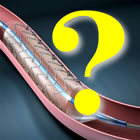 Maryland
interventional cardiologist Dr. Mark G. Midei, who has been under
investigation for "implanting unnecessary stents" in heart
patients, has penned a defense of his medical practice, his first
comment on the subject since the charges were made. Appearing as
a Commentary in tomorrow's Baltimore Sun, Midei's article
is titled
Maryland
interventional cardiologist Dr. Mark G. Midei, who has been under
investigation for "implanting unnecessary stents" in heart
patients, has penned a defense of his medical practice, his first
comment on the subject since the charges were made. Appearing as
a Commentary in tomorrow's Baltimore Sun, Midei's article
is titled 
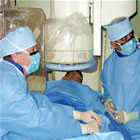 The
European cardiologists don't understand all the fuss in the U.S.
about wrist vs. groin, radial vs. femoral. They use the wrist artery
for angioplasty, stents and catheter access at least half the time
(many 80-90% of the time) and they can't understand why, in the
United States, it's only used in 5% of cases.
The
European cardiologists don't understand all the fuss in the U.S.
about wrist vs. groin, radial vs. femoral. They use the wrist artery
for angioplasty, stents and catheter access at least half the time
(many 80-90% of the time) and they can't understand why, in the
United States, it's only used in 5% of cases. I
had a chance to talk with Alan C. Yeung, MD, FACC of Stanford about
the RESOLUTE US study just presented at the 60th Annual Scientific
Session of the American College of Cardiology (ACC).
I
had a chance to talk with Alan C. Yeung, MD, FACC of Stanford about
the RESOLUTE US study just presented at the 60th Annual Scientific
Session of the American College of Cardiology (ACC). I'm
working on at least six different articles about the many studies
presented at the American College of Cardiology in New Orleans yesterday
and today, from new stents to transradial vs. femoral access, etc.
etc. etc. and suddenly all of this is swept aside by an email that
arrived in my Inbox seconds ago, posting the following to the topic
of
I'm
working on at least six different articles about the many studies
presented at the American College of Cardiology in New Orleans yesterday
and today, from new stents to transradial vs. femoral access, etc.
etc. etc. and suddenly all of this is swept aside by an email that
arrived in my Inbox seconds ago, posting the following to the topic
of