
Washington Convention Center
Over the next three days, a voluminous amount of data will be presented, shared, and debated among an estimated 18,000 attendees of the annual meeting of the American College of Cardiology, this year held in Washington, DC.
While the meeting covers the whole spectrum of cardiology and heart-related issues, there are a number of studies and late breaking clinical trials specific to the subspecialty of interventional cardiology. Continue reading
 On September 22-23, 2016, the 5th Advanced International Masterclass on the Transradial Approach will be held in Budapest, Hungary. And this year, AimRADIAL will be preceded on September 21 by a one-day comprehensive workshop covering all aspects of Fractional Flow Reserve (FFR) from the basic principles and set-up in the cath lab, to the differences between FFR, iFR, and CFR, a comprehensive review of the clinical study data so far, and finally a look at future modalities, like FFR-CT (although the title of that talk by Dr.
  This past week saw publication of an update to the 2007 COURAGE trial which compared optimal medical therapy (OMT) to stenting (PCI) as the initial management strategy for stable coronary artery disease. (Please note the phrase “initial management strategy.” This will not be the last time you see it in this post.)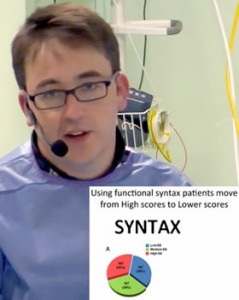

 This week started off with me watching a demonstration of fractional flow reserve (FFR) during multivessel PCI. This very instructive case was transmitted live from Hammersmith Hospital in London and featured Dr. Justin E. Davies showing how to perform FFR and, more importantly, how the use of FFR changed the treatment plan for this patient.
 The coronary angiogram is often referred to as a road map of the heart. As such, it serves the cardiologist and cardiac surgeon well. It shows where the coronary arteries are, how they intersect, the angles of the branches, etc. There are diagrams of these anatomical features in many textbooks, but the reality is that these characteristics can vary from individual to individual, so it’s necessary to get a road map for each individual in whom an intervention is being contemplated. Then, of course, there’s the issue of narrowings in the coronary arteries. Should these receive stents? Should they be bypassed? Should they be left alone and treated with medical therapy?
 RSS Feed